 By Mzimkhulu Sithetho 06 October, 2026
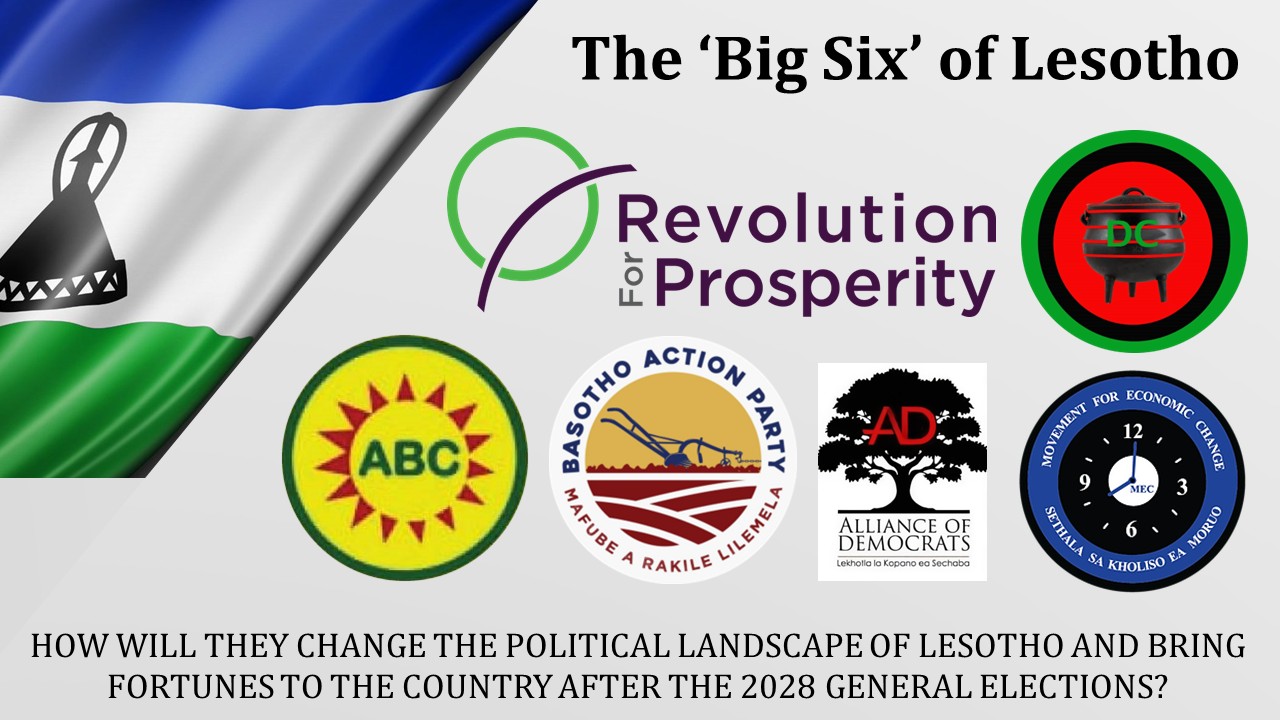
This political analysis looks at each of the six major political parties, with regard to their relative, actual or perceived political strength, political leverage, weaknesses and prospects. These are the RFP, DC, ABC, BAP, AD and MEC). The analysis is of significance to the current and future polity of the country, especially that all roads are leading to the 2028 poll.
Revolution for Prosperity (RFP)
RFP was born in March 2022, immediately faced with a task to prepare to enter the 2022 electoral contest in October of that year. It came with a surprisingly strong electoral capacity, which was built and amassed within a short time.
Formation of the party had not been anticipated before (but not to say that it was unprecedented) in the volatile political minefield of Lesotho. There was no clear possibility of a significant split among the then key political parties, especially those in power.
The splinters that had happened were just small political winds, not major tornadoes. These included the formation of the Basotho Action Party (BAP) and the Basotho Patriotic Party (BPP), ‘Mknondo’ of Tefo Mapesela, which did not do much dent in the political landscape of Lesotho.
As a newcomer, RFP had to prepare itself and position for the October poll. It had to register as a political party, hurriedly put up an office and party structures.
It had to establish a united front of people who did not know each other before, package an electoral manifesto and field candidates in the 80 constituencies.
Also, it was campaign time, and RFP had to hit the ground, convincing voters to vote for the party. It had to decide on what to sell to Basotho so that they vote for the party. All this was done in seven months – between March and September 2026.
All went well. The RFP took its competitors and the voters by surprise when it seized the reins of power in its very first attempt at the poll. It completely changed the whole political landscape when it headed straight to the state house.
It became the second party to occupy state house after formation within less than 10 months, following the Lesotho Congress for Democracy, LCD which was formed in June 1996, only to come out victorious in an election held in May 1998.
LCD had split from the Basutoland Congress Party (BCP), a revolutionary movement led by the late political icon, Ntsu Mokhehle. LCD snatched 79 of the 80 constituencies and formed government alone. However, the post-1998 election was marred by political riots, which turned sour, leading to burning and looting in three districts of the country.
RFP has the advantage for the 2028 elections because it still enjoys incumbency. It got 199, 867 votes in the 2022 poll, making the party to get a total of 57 seats. RFP is leading a three-party coalition with the Alliance of Democrats (AD) and the Movement for Economic Change (MEC).
Others that are in the coalition are the LCD, Lesotho People’s Congress (LPC), United For Change (UFC) and HOPE-Mphatlalatsane. In terms of popularity, the RFP has made its mark in the last four years since its inception on 22 March 2022.
It stands at a vantage point of using its scorecard in infrastructure development – roads, bridges etc. It has connected water and electricity. It made some inroads into agriculture.
However, there is signal that these have translated to economic development with a change in the people’s livelihood development.
There are still shortfalls such as public service delivery, which has not improved, investment and probability for sustainability of the economy of the country.
Also, the RFP is leading governance change by holding the torch of the national reforms. These come with constitutional, legislative, policy, institutional and administrative change.
Also added to these is the fact that the Prime Minister, Samuel Matekane and those with whom he is leading government have given the impression of leading an entrepreneurially-aligned government because they are entrepreneurs themselves.
The last poll saw business capture power from the jaws of politics and turning it into a political machinery. As a result of the above-mentioned, the RFP has high political leverage with which to politically maneuver to get to state house again, of course through a coalition arrangement.
However, perceptions of rampant corruption that is state-sponsored remove points from the RFP. Continuing voter fatigue may affect the party it does not work hard to appeal to the masses.
The defections in the party in the national assembly have seen its three (3) MPs landing in the DC and the two (2) in the BAP.
Democratic Congress (DC)
DC is the most obvious challenger to the RFP, having come second in terms of numerical strength and the number of parliamentary seats. The DC got 128,105 votes in the 2022 elections, giving it 29 seats in the National Assembly.
The party obtained 24.9 percent of the vote. It is the Official Leader of Opposition in the National Assembly. The DC is leading the opposition bloc, especially during negotiations and consultations on the national reforms.
The DC has the capacity to position itself as the alternative government, beyond being a mere opposition leader.
The party has experience in government in 2015-2017, where it was leading a 7-party coalition government and in 2020-2022 when it was deputy to the ABC in a coalition government.
These two stints in the upper echelons of political power positioned the DC as an established political organization in terms of governing experience.
Some of the strengths of the DC, which the party needs to leverage on include its being the second largest party according to the 2022 national elections.
It has a strong rural support base, which has formed part of its majority seats in the `national Assembly.
The DC, as a congress party, has firm and well-established national, district, constituency and branch-level structures, which are an engine for any party viability.
Congress parties across the board, beat their counterparts when it comes to strong and firm structures across all levels. They are grounded in grassroots politics, while others just come out as ‘briefcase parties’ with no grassroots (real people) orientation.
Structures help a political party to create a grand hierarchy, especially for devolution of power and authority from the National Executive Committee (NEC) to the branch committee in the village. Though, NECs of political parties, across the board, concentrate power at the top.
When RFP MPs and members get disgruntled with the ruling party, the alternative political home to which they can defect becomes the DC. This is mainly due to the DC’s strategic positioning as the second largest party.
However, the DC’s undoing is its association with previous governments, which have been a thorn on the skins of citizens. This is against the backdrop that the DC is relatively not a too old party.
There is a political narrative that is haunting congress parties, that the congress movement’s moment has long been vanquished and that it has lost its grip on power.
The first beating of the political monolith that used to be associated with the congress movement was in 2006 when the ABC, now a political minnow was born out of the LCD.
Therefore, the DC is directly linked with the vanquished congress movement and it is the only remaining shining armor. The demise of the DC puts the final nail on the congress’ coffin.
Another frailty eating into the DC is the fragmentation within the broader opposition, of which the party is not an exception.
All Basotho Convention (ABC)
The ABC is one party that had enjoyed a steady and incremental growth from its inception in 2006 to the point of its dramatic decline in 2022.
After its inception in October 2006, ABC had 17 seats in the National Assembly, making it the third biggest party in Parliament then, following the LCD (then whittled down to 62 seats) and Basotho National Party (BNP), which had 21.
However, BNP had gone down with the formation of the Basotho Democratic National Party (BDNP).
ABC dramatically changed the political climate of Lesotho in 2006 and went on to contest the February 2007 snap poll. In fact, the 2007 poll was called early because of the existence of the ABC.
Then, a newcome in the political arena, destabilized the political game, especially challenging the power of the incumbent LCD, from which it had splintered.
The LCD had, for the first time, a challenger to the throne it had established for itself since 1997, when it was established by the liberation icon, Ntsu Mokhehle.
LCD had grown to become a dominant factor in Lesotho’s politics until it had hegemony over the body politic of the country.
Since 2002, LCD had seen through the political frailty of the BNP and had a smooth sailing in the politics of Lesotho, becoming this powerful political monolith that was hard to break.
The period 2002-2006 had manifestly become the political turf of the LCD, holding fort and standing unshakeable, as the opposition had been crushed to the ground.
It was a time when the BNP, the second-biggest party after LCD and its obvious challenger, was torn by internal rifts and wrangling for power.
This gave the LCD a lull and the unchallenged power to dominate the country’s politics. However, this state of affairs worked against the LCD, which now experienced serious internal rifts, emanating from power jostling among the ruling party’s big wigs.
With little external challenge, LCD’s big wigs faced each other and exchanged heavy political artillery, seeking to emasculate each other. This is the political undoing of congress parties in Lesotho, whose top leadership come together when there is an external challenge, but embark on internal rifts during a political lull.
The founder of the ABC, Dr Thomas Thabane, who was then a critical factor in the LCD was pushed to the margins of the party until he jumped ship to form ‘his own thing,’’ this heralding the birth of the ABC.
In fact, one of the biggest political undoings of the LCD to the fact that today, it is just a political minnow is the perennial internal power jostling where the big wigs engaged in a war for grabbing the leadership of the party.
This was just under the nose of the leader, Dr Pakalitha Mosisili, who was seen as a lame duck while his troops tussled among themselves for his seat ‘while the King is still on the throne.’
The peculiar behaviour gradually decimated the LCD until it got politically emaciated to become the ‘political no-body’ that it is today.
The ABC had grown from 17 seats in 2007, 30 in 2012, 46 in 2015 and up to the highest of 54 in 2017, where the only 10-year-old party nearly got the 50+1 threshold, that would make it govern alone.
ABC was at its highest in 2017 and got into a coalition with the AD, a splinter from the DC, led by the political heavyweight then, Monyane Moleleki and the BNP under Thesele Maseribane.
Also forming the formidable 4x4 brigade was the Reformed Congress of Lesotho (RCL) led by Keketso Rantso, who had broken ranks with the LCD’s leader, Mothetjoa Metsing.
ABC led the 4x4 government, after the three leaders, Thabane, Maseribane and Rants’o returned from a self-imposed exile in South Africa for almost two years.
After seizing reins of power in 2017 national elections, the once politically vibrant, ABC’s leader, Thabane had become substantially frail, health-wis, this being aggravated by his old age.
For the once powerful Thabane, a serious political powerhouse of Lesotho during the hay days, his political fortunes had now become undermined by his ill-health. This was now to the extent that running government had become burdensome.
This state of affairs of the ABC leader was also aggravated by his wife’s vibrant character, which adversely affected the party’s ability to hold the fort as she made unwarranted intrigues and interferences on the throne, undermining the might of the King.
‘Maesaiah Thabane became a queen that sought to seize the throne when the King was still alive, taking advantage of his ill-health and old age.
The ABC lost its throne in 2020 when shenanigans in the party and in government led to the demise of the leader, forcing then Prime Minister, Thabane to abruptly relinquish power to Dr Moeketsi Majoro a deputy who was never a deputy.
The early retirement of Thabane was catalysed by the passage of the The Ninth Amendment to the Constitution of Lesotho: Restricting the Prime Minister’s power to dissolve Parliament.
The Ninth Amendment to the Constitution of Lesotho, 2020 was introduced to limit the ability of a Prime Minister to advise the King to dissolve Parliament and call an early general election, particularly after losing the confidence of the National Assembly.
Thabane was the first and only Prime Minister to fall victim to this Constitutional change, which sent him home when he was forced to resign after losing the confidence of the National Assembly.
Majoro was in Thabane’s camp after the leader had banished his legitimate deputy, Professor Qamako Mahao and those with whom he had been elected at a conference in 2018 to political wilderness,
The ABC got entangled in an unending internal warfare, which pitted the party’s big wigs into two key factions – those who followed the leader Thabane (dubbed ‘mabulumara’) and those who were behind his deputy, Mahao (dubbed ‘likatana’).
In 2020, at the height of the COVID-19, there was a political coup against Thabane by a faction led by Mahao.
This was after the Mahao faction, courted the DC, which was then, occupying opposition in the National Assembly to form a Government within the tenure of another government.
Majoro was installed during the height of the COVID-19, to become the country’s fifth prime minister, deputized by the DC’s leader, Mathibeli Mokhothu, who had succeeded Mosisili.
The ABC underwent a series of rough political patches from 2020 up to 2022 when it tasted its major political blow, a painful moment when it was relegated by the voters to the ashes of political oblivion.
In the highly contested elections of 2022, ABC suffered one of its greatest blows when it got only 8 PR seats, no singly constituency seat nothing, but mere PR.
This was now under a new leader, a young and vibrant, Nkaku Kabi, who had been groomed by Thabane to take over, this, after ditching the blue-eyed Majoro.
Kabi had joined the political train in 2018 when he was appointed Health Minister, kicking out the now deceased Nyapane Khaya.
Khaya, Motloi Maliehe and others’ fall from the throne was a machination by the Frist Ladym, Maisaih Thabane, who was wielding a unauthorized power, under the behest of his husband.
ABC has since the 2022 poll, being navigating pathways for political recovery from the political abyss to which it been thrown by political errors of its own.
Political analysts argue that the ABC needs 10 years to get a grand recovery so that it can get at least 10-15 seats and then grow gradually from that to get to its former glory.
But with the current demise in which it has thrown itself, again, having reverted to its old ways of internal rifts, there is no signal that the once vibrant ruling party could recover.
The political fortunes of the ABC are now a spilt milk, for which those who worked hard to establish it are crying, but cannot regain it. But they say, never say never in politics.
Basotho Action Party (BAP)
The BAP is a splinter party from the ABC, formed by Professor Mahao as a last resort following years of fighting with the Leader, Thabane. Mahao had to throw in the towel that he would never have a comfortable stay in the ABC as his coming was never welcomed by the Leader and those who were close to him.
The pitting of Mahao and his Leader created serious acrimony in the ABC until he jumped ship to form the BAP in 2022.
BAP became a formidable force to be reckoned with in the political of Lesotho, but this being for a short stint, until its fortress was stolen by the newcoming RFP, which came in a heavy force to still the limelight. BAP got relegated to the doldrums.
As the road to the 2022 poll got dusted, BAP was not to be seen any more, but the party performed relatively well in the election, getting six PR seats and becoming the fourth largest party in parliament.
However, as it is often the case in Lesotho’s nascent party politics, BAP sunk to the internal rifts, which tore it right in the middle, this after it bought into the idea of joining the RFP-led coalition government.
BAP became a messiah that salvaged the RFP-led coalition from falling when a motion of no-confidence against Prime Minister Matakane was filed in the National Assembly.
The party’s six seats added value to bolster the coalition’s meagre 65 to make it 71 in 2023. Others like the LCD also came to the party with its three seats to stop the fall of the regime.
However, it was not long when the party’s leader, Professor Mahao did not see eye-to-eye with Matekane and the RFP that he was elbowed out of Government. He has his embattled Deputy Leader, Motlatsi Maqelepo serving in the Government, sailing against the leader and the party’s resolve to leave the government.
In Parliament, the party was torn into two factions, with a heightened drama with one side for remaining on the Government side, while another has been for occupying opposition seats.
The BAP impasse in the legislative house has not been solved as the two factions have stood on opposing sides until the party got an olive branch with two more seats when two RFP MPs crossed the flow to join BAP.
The party has since released a salvo against the Deputy Leader, Maqelepo, who stands fired according to court judgements.
BAP can still leverage its unexpected lift from the RFP to bolster its membership in the august house to go to the 2028 poll with a fresh manifesto to the voters.
It needs a new thinking from the leadership and adopt a more democratic style.
Alliance of Democrats (AD)
The AD is a splinter party that was formed as a breakaway from the DC, just five years from its formation in 2012. The leader, Monyane Moleleki had broken ranks with his Leader and erstwhile political friend, Mosisili.
Unlike other parties, the AD’s formation did not create much fanfare, except that it was born out of a bitter spat between two key political heavyweights who did not see-to-eye.
It had long been rumoured in the political circles that Moleleki would not climb the ladder to succeed Mosisili in the DC. A new successor was being silently groomed somewhere, Mathibeli Mokhothu.
Moleleki smelt the rat as the suspicion that he would see DC’s leadership inside the tea was growing.
The fortunes that he built over the years when also, it had seemed impossible for him to clinch the LCD succession had been shifted elsewhere.
A bitter spat had ensued between him and Mosisili and his bitterness was justified because Moleleki built the DC from ashes, when the political antennas were doing the different direction in the LCD.
He was able to soothe Mosisili to his fold and win him to lead the DC when the rift between the lija-mollo and litima-mollo factions had reached fever pitch.
During the biggest seven-member coalition government, Moleleki did not have a smooth political stay in the DC, though he was the second-in-command.
The seat had been occupied by the LCD leader, Mothetjoa Metsing, his former nemesis in the LCD, with whom he had jostled for control of the LCD until he and Mosisili had jumped ship to form the DC.
But now, they had been brought together by political circumstances that had bedeviled the fragile 2012-2015 ABC-LCD-BNP coalition.
LCD had to eat a humble pie and rejoin its former nemesis, the DC and others to forge a coalition to clinch power in 2015-2017.
However, as it is in the DNA of Lesotho’s nascent politics, the seven-member coalition was thrown into oblivion by the internal wrangling that had eaten into the DC and the it was dethroned in the 2017 highly-contested poll.
ABC became victorious and led a 4x4 coalition government, where the AD was a grand partner, having taken the second-command of the coalition, hence, pushing the DC to the opposition side.
Moleleki was described by others as having strategically and politically buried the hatchet with Thabane, who was his master in government. The steered the 4x4 government together until the monolith broke during the COVID-19 in 2020. That was the demise of the AD, which was whisked out of power by the coming of the DC into the fray.
Moleleki suffered another blow, once again, been relegated to the back bench and possibly placing the last nail on his political career, especially of becoming a Prime Minister.
Worse still, another blow to Moleleki, this political episode deprived him the opportunity enjoying deputy prime minister retirement benefits, as he did not complete his 36 months period as the second-in-command in government.
The AD’s political misfortunes were sealed as the party had to tussle it out for the next election, which was even more competitive.
The party had to craft a new election campaign strategy if it were to be a formidable force to be reckoned with among voters.
Now it was time for the leader to leave the stage, which he was quick to announce that the party should look for someone who would contest in his constituency of Machache.
Later, Moleleki changed heart and said he was standing in 2022. But the party had sought to find a replacement and refused him another opportunity.
He stood for elections in Thaba-Bosiu, riding on his ability that he made formidable developments in the constituency, but luck was not be to with him as he lost to an RFP member. He is just a back-bencher PR MP. This was another straw on Moleleki’s long-standing political career.
The AD went to an elective leadership conference in 2023, wherein this time, Moleleki had a challenge to the throne by this Deputy, Professor Ntoi Rapapa, whom he had politically groomed.
Moleleki was befallen by yet, another blow in his political life and had to wake up and smell the coffee.
He even failed to provide a smooth transition to his proper retirement like his erstwhile leader, Mosisili, who voluntarily stepped down and passed on the baton to Mokhothu, who, today, still accords him the respect of a political elder and statesman.
Not the case with Moleleki. He was abruptly toppled from AD leadership, whisked out of political power and made to end his political career in such a degrading, shameless manner.
Moleleki’s charismatic and jovial character in the politics of Lesotho is remembered with a bitter pill that he is going down the political trail with an egg on his face.
History sometimes judges some people harshly and Moleleki is one of those political leaders who will retire from politics in the worst manner.
Some pundits have argued that Moleleki was better-placed as just a prominent member of whichever party he was in, not as a leader, which now demanded him to take a strategic leadership role.
For the AD to reinvigorate its political wealth ahead of the 2028 elections, it needs a strategic ability, especially from the leadership.
The party lost a great deal of its core leadership to the new RFP. Its political machinery has not been a strong one from the onset and it needs to reposition itself for the next poll.
The Leader, Professor Rapapa has played a crucial role in the RFP-led coalition government that seized reins since 2022 elections.
The AD has a comfortable stay the RFP-led coalition government given the level-headedness of the Leader, Rapapa, who has calmed the storms in a politically-charged environment.
The AD’s benefit as all roads lead to 2028 is the fact that it enjoys incumbency, which comes with access to recourses, free publicity and other attendant benefits that come with incumbency.
However, it may reap the negative fruits of being associated with the failures of the coalition government if the opposition was to put up a strong case for the coalition’s frailties.
The Afrobarometer survey of 2024 placed the AD on 2% regarding citizen perception of the party, which is a low for a party that still years to steal the hearts of voters.
The only last opportunity remaining for the AD is to position itself not as a victor of elections, but a recognizable power broker for the forthcoming election.
Movement for Economic Change (MEC)
MEC is the last in the big five of Lesotho, with four (4) parliamentary seats, by the 2022 poll. MEC was formed as a splinter of the LCD, when the then Secretary-general, Selibe Mochoboroane of the LCD, sharply differed with his leader, Mothetjoa Metsing between 2015 and 2017.
It was formed on February 2017, on the road to the highly-contested June 2017 election, which was its first to participate in as a party.
Its formation was led by the then firebrand, high performer and pragmatist, Mochoboroane, who had strategically positioned himself as ‘the leader.’ This infuriated LCD leader, Metsing, who felt that Mochoboroane, his junior, was stealing glory under his very nose.
It has long become unholy tradition within political parties that juniors do not seek to outsmart their masters, especially in the congress movement, but also in other political areas.
Mochoboroane played his cards close to his chest and became a silent contender, hideously pitting himself against his master, Mothetjoa Metsing.
But this secretive move was discovered and was gradually gaining momentum within the party’s top echelons, creating discomfort that grew to the level he had to face a disciplinary action within the party.
Mochoboroane had been whispered to be harbouring leadership ambitions when he was the LCD’s uncontested Secretary-General, seeing himself as leading the party, this to the discomfort of his leaders.
He had charged that the leader, Metsing, was not longer attractive to the larger populace to entice new people to join the party.
Riding on his high performance in Government, even earning the mantra of ‘e mots’o moratuoa’ Mochoboroane used the Ministry of Energy’s exposure to energy projects.
He spiritually led the rural electrification to gain voters’ support, but got the blemish that he did not attribute these successes to the Leader, Metsing. He lashed out when faced with these blemish statements, which showed signals he was up to something.
He jumped ship in 2017, a year of elections to form the MEC, leaving the Small Business Development Ministry, this after he had gone the length and breadth of the country, amassing the small and medium enterprises (MSMEs) support base at the grassroots.
During the period 2017-2022, when he was occupying an oppositional seat in parliament, he was elected to the high-level position of Chairperson of the Public Accounts committee (PAC).
The PAC commit is the bulwark against executive corruption, exposes execute malfeasance and, in some instances, can largely damage the executive and political image of ruling parties.
Mochoboroane rode on his leadership of the PAC to expose rampant corruption in the Thabane’s 4x4 government and those that came before it.
He became a scarecrow of many government departmental heads who fiercely feared appearing before the PAC, especially those who knew they had something to answer before the Committee.
Mochoboroane built his and that of the MEC’s political weight as a fighter against widespread public service corruption. He built his party’s mantra for economic empowerment.
MEC is part of the RFP-led coalition government and is playing a catalytic role as a balancing force in the politics of the coalition.
MEC rides on the party leader’s impressive performance credentials to remain relevant in the highly volatile partisan politics of Lesotho, where a political party swiftly dives into oblivion within a blink of an eye.
MEC needs to reposition itself, not for winning the next poll, because it is far-fetched, but can only fight to become a recognizable power-broker for powerful political players.
If the party is to be anything to be reckoned with, it needs to cling to the RFP to the period after elections.
The shenanigans that have bedeviled Mochoboroane while he held a stint in the health ministry, which pushed him to Agriculture and Food Security seem to have not dented the MEC and its leader’s political spoils.
MEC is still a young party, still below 10 years and it has not gone above 10 seats in parliament in the two elections it has contested. It is led by someone who is also young.
For the party to make a formidable comeback in the 2028 elections, it needs to refocus its strategic thinking around the fight against corruption, ethical business and the fight for youth economic empowerment. It is not strong on this front, though it inherently features in the party’s political mandate.
ABC, BAP, AD and MEC
The four political parties, with the exception of the RFP need to take a serious and well-thought-out political strategy going to the 2028 polls, otherwise, they will join other former ruling parties that have now been thrown into political oblivion like the BNP and LCD.
The next 2028 election is going to be a clash of the titans, which is going to be a catastrophic battle for the state house, with the DC demanding to make inroads.
The best the four parties can do is to individually take a strategic move of becoming recognizable power-brokers, because wiling an election is a closed chapter for them.
The 2028 poll is going to be a heavy tussle between two key political parties – the RFP, which will be fighting tooth-and-nail to protect its turf and to come against, even if it means with reduced numerically strength.
The second fighter in the election will be the DC, which will be fighting tooth-and-nail to take the throne and get to state house. Surely, if it does, it will render the RFP an opposition without choice.
The 2028 election may become an interesting poll because it may see the RFP and DC cobbling a two-party grand coalition, with each inviting its ‘political friends’ to the party. This is what happened when government changed in 2020 without an election.
DC will come with ABC, PFD, BNP and small others, while the RFP will invite the current partners if they will have behaved up to elections.