 By Mzimkhulu Sithetho 08 October, 2026
MASERU 05/10/2026 – This political analysis is a deeper examination of the performance of five big parties that participated in the 2022 national election. It forecasts political prospects for the 2028 national polls, using the 2022 elections as a baseline in terms of political strength, political leverage and likely coalition arrangements to be formed ahead of or after the poll.
The political analysis takes a deeper assessment of how the five major political parties that contested the 2022 national elections fared in the last election, unpacks their current political strengths and weaknesses and their political, electoral and parliamentary leverages.
The analysis is based on the 2022 national elections, which are going to be used as a baseline for forecasting likelihoods in terms winning the election, coalition arrangements that may be formed and the kind of government that will come out of that poll.
Political context after the 2022 national poll and prospects going to the 2028 poll
Glancing back at the 2022 national poll, the election of that year was contested by 65 political parties. However, the Independent Electoral Commission (IEC)’s records a number of registered political parties to be standing at 42.
This number of political parties is believed to be too high for a country that has a final voter turnout of 515, 281.
Most of the political parties have turned out to be spoilers of the elections, with each grabbing small votes in different constituencies. Lesotho needs just a few, but strong and effective political parties.
The 2022 election came out to be one of the highly competitive polls since the introduction of the Mixed Member Proportional (MMP) electoral model. This was prompted by the fact that there was a newcomer in the election, the Revolution for Prosperity (RFP).
The RFP took its competitors and the voters by surprise when it seized the reins of power in its very first attempt at the poll, completely changing the whole political landscape.
Formation of the RFP had not been anticipated before in the volatile political minefield of Lesotho, as there was no clear possibility of a split among the then key political parties, especially those in power.
These were the ABC, then leader of Coalition and the DC, second-in-command in government.
RFP came to be an amalgamation of all Lesotho political powers as it did not come out as a splinter of anyone political party. Eyes had been on the BAP, which was a breakaway of the ABC.
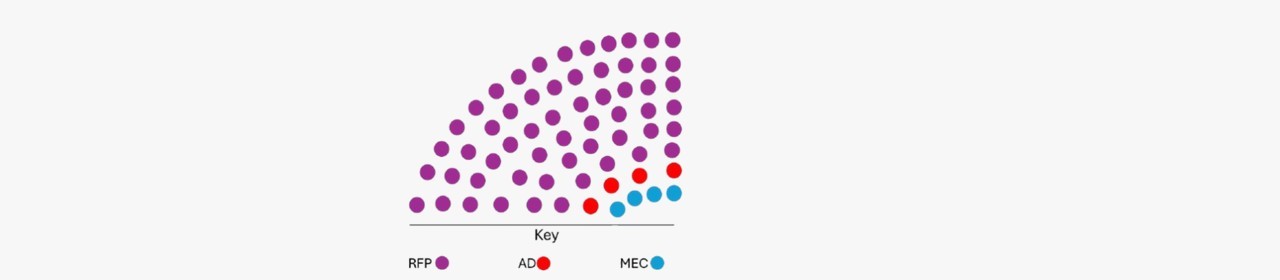
RFP came out of the poll victorious, with 56 parliamentary seats, followed by the DC that had 29 seats. Others – the ABC with 8 seats, BAP 6 seats, AD 5 seats, and MEC 4 seats. However, AD’s numerical strength was reduced the MP for Malingoaneng, Mokoto Hloaele defected to the RFP, increasing its current seats to 57, while leaving the AD licking its wounds with 4 seats.
The rest of the parties shared the cramps from the table after these big five had had their share of the pie. They got from three (3) to one.
The lion’s share had already gone to the RFP and DC, which got a two-digit number of seats of a 120-member parliament. To meet the 50+1 threshold, the RFP had to court other parties, with whom to form a government.
Originally, the RFP had cobbled a coalition with the AD and MEC, which made about 65 seats. This was just a simple majority government, but which was vulnerable as it did not have the numerical strength to resist any challenge to the throne or pass constitutional Bills.
Other coalition brokers were the ABC, BAP and LCD, which had 8, 6 and 3 seats respectively. However, none of them came on board until later when the government’s survival was hanging by a threat, as a result of a motion of no-confidence filed by the Basotho National Party (BNP) in October 2023 that BAP joined the bandwagon.
The RFP-AD-MEC alliance was not a comfortable majority as it was only 4 seats above a bare majority and threshold to form a government of 50+1 in percentage. That is why the coalition government was threatened by a vote of no confidence motion filed in October 2023. RFP was forced to frantically search for an additional political ally (s) to stabilize the government in parliament.
However, the debate on the motion was delayed and stalled by legal challenges and court applications for constitutionality and procedural matters surrounding the motion. It was therefore short-lived due to a serious political chess-game at play then to downplay it.
Matekane and his circle had to unleash a heavy political artillery to fend off the motion. One of the political strategies was to bring on board, political parties that were on the periphery, the BAP and ABC with the BAP agreeing, but the ABC refused. BAP has since ditched the coalition, a year in power, when it withdrew its participation in November 2024.
During the period, RFP used the grand opportunity to court other parties to come onboard in order to fend off the motion or any other future motion. BAP’s agreement to join the bandwagon increased the numbers of coalition parties in government from four to five. The BAP brought with it six seats to make the new RFP-BAP-AD-MEC climb to 71 seats.
However, the new development also fell short of nine (9) seats to give the RFP and its allies a comfortable two-thirds majority to govern smoothly. There are other political parties that support the RFP-led coalition on the sidelines – the United for Change (UFC), HOPE-Mphatlalatsane, Lesotho Congress for Democracy (LCD) and Lesotho People’s Congress (LPC).
Currently, there seems to be a political lull as the RFP-led coalition is comfortably governing with no significant challenge from the DC-led opposition.
As matters now stand, the DC, BNP, ABC and PFD and other small parties have tried to release their political salvos to shake the RFP-led coalition, but to no significant appeal to voters. Complaints have included corruption, poor service delivery and other shenanigans.
Poll survey – voter sentiments on which party would be voted if elections were to be held immediately in 2024
The Afrobaromer, working alongside the Advision Lesotho, conducted a survey that probed the voters’ sentiments if elections were to be held immediately in 2024.
RFP received 29% of voters saying they would retain the party leading government. DC got 21%, ABC 6%, while AD and MEC got 2%. BAP was the final one with 1% probability for being voted into power.
Though the survey results did not present an election forecast for 2028 elections, they provided voters’ sentiments at that time, probably half way towards 2028. This was what could be referred to mid-term elections in the United States of America.
Overall 2028 political assessment – weak opposition and a political lull
Going by the current state of political landscape and the political-chess game at play, the RFP seems likely to come out victorious in the next poll. However, this will be with a slight decrease in parliamentary representation.
The party’s numerical strength may be dwindled not by outside challenge, but by internal rifts and wrangling that has the potential to tear the party apart.
Some MPs may not be fielded to contest the next poll, and voters may be angered by the move, and give their votes to a different party.
There are currently no signals that indicate that the axing of the Teyateyaneng MP, Lebona Lephema from cabinet may have significant impact on the party’s strength. Also, he has not yet indicated his desire to ditch the party and form a splinter, at least for now.
However, he seems to be holding sway over a good number of MPs and constituencies. If the RFP was to put its house in order, it may come out stronger than it was when it entered the electoral race in 2022.
The party has put up a number of promising developmental projects such as electricity connection, youth development programmes, agricultural production, roads and bridge construction as well as rolling out Maseru city in terms of road network and facelift.
Nonetheless, there is no indication that the party has put up formidable steps towards economic growth, that would herald development of the country.
For the opposition, there is still a challenge of a united front to put up a strong political challenge to the RFP-led coalition.
Except for the national reforms, the opposition is fragmented and weak to convince voters that the government has drifted away.
The opposition’s political machinery is weak to make a formidable message to be taken seriously by the voters.
On the contrary, the RFP and its coalition partners also have a weak political and public relations machinery to put up a defense mechanism to the voters.
Moreso, all opposition parties are internally torn by periodic intra-party conflicts that have project doom for a strong opposition.
The DC, ABC, BAP, BNP, LCD all have their own internal rifts that are likely to tear them. Already, the DC has had a splinter, led by business tycoon, Bothata Mahlala.
ABC has just had its share of the pie with serious internal rifts that have seen the entire National Executive committee, except for the leader, resigning. BAP has fought it out in the courts of law and is also torn right in the middle.
-End-